A Moment in Patagonia
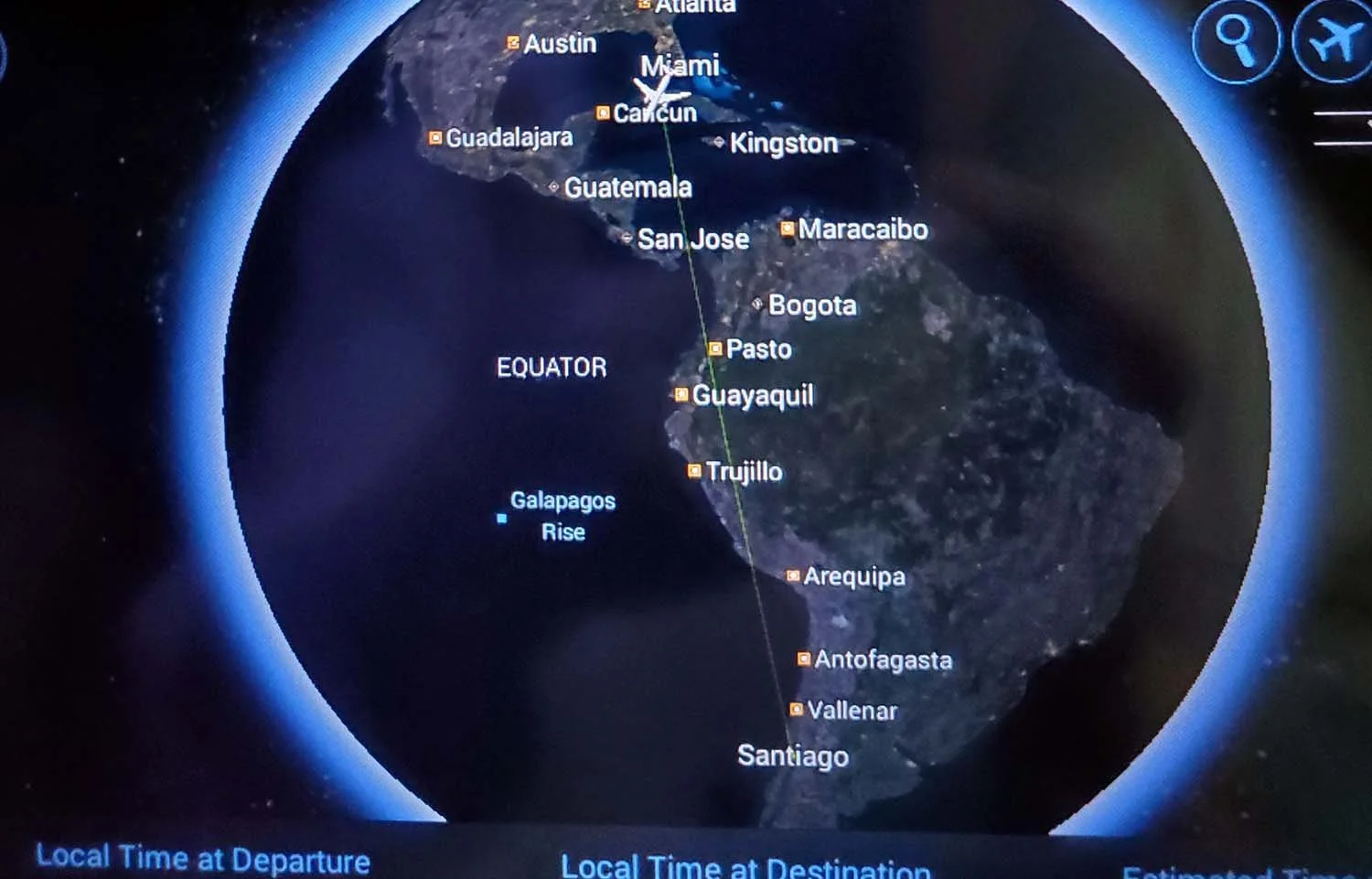
Miami to Santiago
Almost Entirely Over Water.
A Moment in Patagonia
The colorful mysterious continent of South America has fascinated me since elementary school, but I know shockingly little about it. I have visited Cartagena, Colombia, on a cruise through the Panama Canal and our daughter participated in an expedition to study and record ethnology and musicology in Suriname. I’ve seen movies of ancient ships tossed about by ferocious winds and waves rounding Cape Horn and current news reports alert me to dangers in Venezuela.
I want to know more!
Ron and I are way past the age and physical condition for backpacking or even hopping from country to country by plane and rental car. But we have developed a measure of know-how in the use of cruise lines for opportunities to see, smell, taste, and feel elements of cultures different from our own.
My knowledge begins to expand the moment we book an eighteen-night cruise on Viking Jupiter from Santiago, Chile, to Buenos Aires, Argentina, with a stop in the Falkland Islands.
“We sail in late January and early February,” I say to Ron. “Our winter is their summer. Just how hot or cold is it going to be?”
“It’s their summer,” he answers, “but we’re going all the way to Patagonia and Cape Horn. That’s almost to Antarctica!”
“It’s got to be cold there,” I chime in. “And where are the Falkland Islands?”
“And just how close to Venezuela are we going to be?” Ron wants to know.
Those questions send me to the globe to see exactly where we are going, and Ron to the computer to find average temperatures for our itinerary.
South America is much bigger than I realized. Our eighteen-night cruise will cover only the southern third of the continent. We live closer to Venezuela here in northeast Florida than we will be at any time on our journey.
Ron finds out we will need to pack for temperature swings from sixty-five degrees in Santiago to the low forties in southern Chile, and as high as eighty-five degrees in Buenos Aires.
“What about the high winds at Cape Horn? We’ll need warm jackets there,” I say, stating the obvious. “And what about Patagonia? It’s not shown on our globe, and I don’t find the Falkland Islands, either.”
Choosing from the recommended reading list, we bone up on Chile, Argentina, Uruguay, the Falkland Islands, and Patagonia.
During all my years in New York, I never saw the Broadway show Evita, and neither of us had seen the movie, so we watch it on TV--twice. Reading Patagonia by Chris Moss, we learn that it is a region covering parts of Chile and Argentina. Isabel Allende’s novel The House of the Spirits introduces us to three generations of a Chilean family.
We pack layers for hot and cold, managing to stay under fifty pounds in each of two bags.
When the day finally comes, we fly from Jacksonville to Miami, and then nine hours to Santiago. To my surprise, the flight is almost entirely over water. A cruise representative meets us at the airport and accompanies us, along with about twenty others from our flight to the bus for Jupiter, two hours away in the Port of Valparaiso.
We ride through desert-like mining country described vividly in Allende’s novel. We pass what appears to be a workers’ blockade with half-a-dozen men guarding the gate of a dirt road entrance.
At our destination, we are directed to an open-air shelter with immigration officials stationed behind elevated counters. Our documents are silently, quickly, and thoroughly checked, and we progress to the ship. The welcome aboard champagne is a little more than we can handle with canes and carry-ons, so we smile our thanks and continue to the designated muster station for a safety briefing.
Our bags are waiting for us in our cabin and soon we are comfortably settled. Like other Viking ocean-going vessels, Jupiter hosts about 900 passengers. We visit our favorite spaces in the familiar deck layout where we will view, read, write, talk, and enjoy live music between meals and lectures.
Enroute to the Chilean Fjords, our ship stops at Puerto Montt. We travel by bus to Llanquihue Lake where snowcapped volcanoes serve both as backdrop and reflection in the clear blue water. The nearby village boasts multiple German bakeries and a Mexican cantina, delicious evidence that South America receives immigrants from many nations.
Scenery within the Chilean Fjords is bigger, older, and more rugged than I had expected. Dolphins, whales, and all manner of seabirds, including an albatross accompany our ship all day.
Approach Amalia Glacier, we join fellow travelers in the Explorers Lounge, a spacious area surrounded on three sides by floor-to-ceiling glass and furnished with comfortable sofas, easy chairs, and small dining tables. We watch in awe as a field of ice between two mountains comes into view, growing and shifting shape as we progress. Captain Larsen swings the ship slowly around to port side so we can see the glacier’s crags and caves up close. Then he swings the ship slowly back toward starboard.
I nudge Ron, “Maybe now we can see it best from our veranda.”
We head for our cabin. There we feast on an almost touchable view of the expansive frozen river lodged between towering mountains and stretching way beyond.
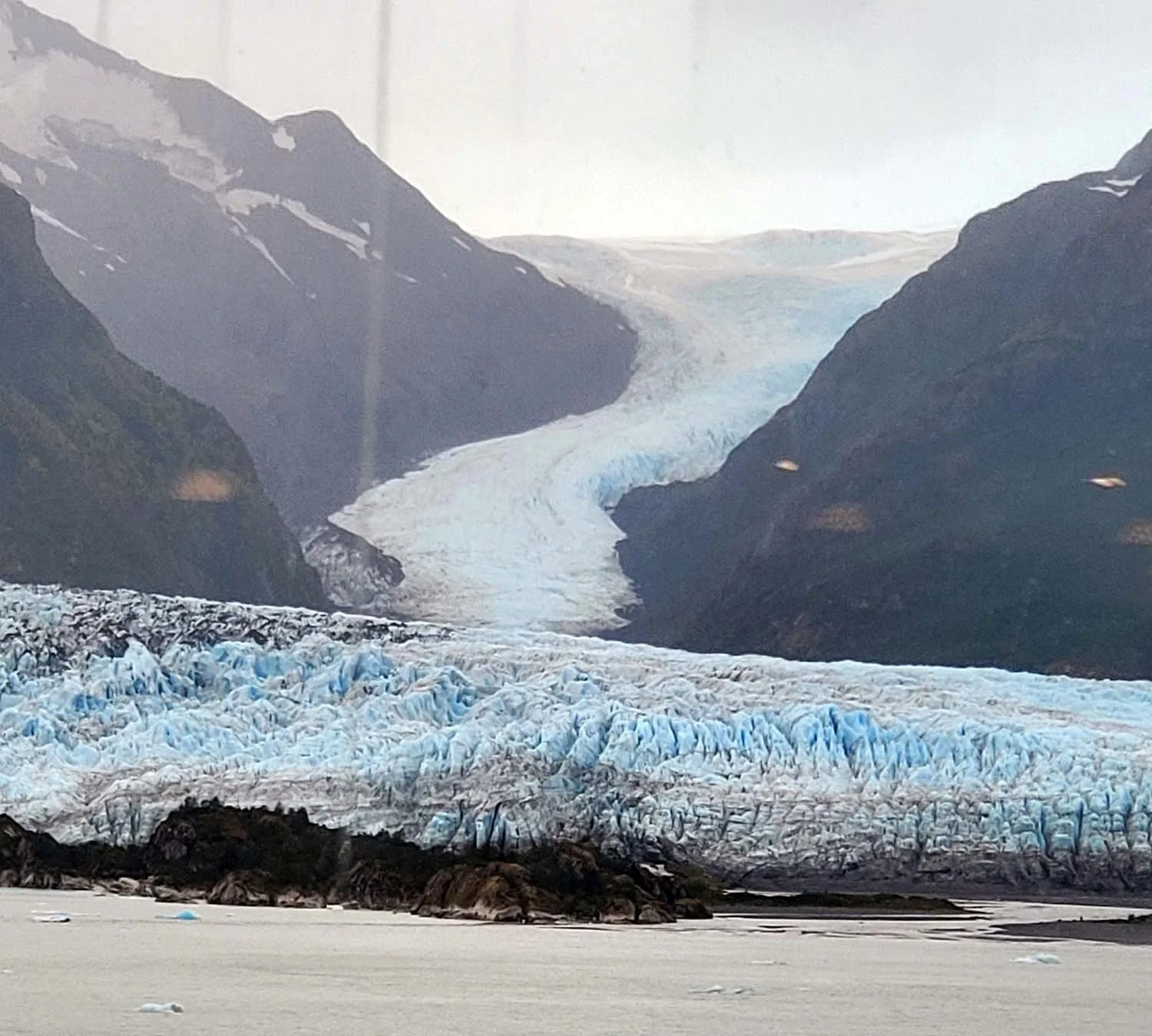
Amalia Glacier, Chile
When Captain Larsen announces that we will enter Patagonia’s Glacier Alley in Chile’s Beagle Channel at approximately 5:00 the next morning, we take a deep breath and resolve to be awake. The alarm goes off at 4:00 and we don jackets, scarves, and hats. We arrive in the Explorers Lounge at 4:30. The lone staff person up and about at that hour sees us wondering where to sit for the best view and directs us to a pair of comfortable chairs near the front and slightly starboard windows. We are the only passengers there for the next ten minutes. Gradually other spectators appear in winter garb. Some choose to sit or stand inside the glass walls and others go directly out on deck.
As if on cue, the first glacier appears at 5:00. In the dim morning light, we see a deep field of ice nestled high in the craggy mountain. We watch the glacier evolve as we grow near. No sooner has that one passed beyond our view than another comes into sight, and another. For the next two hours we watch gigantic grey rocks adorned with spectacular hanging and tidewater glaciers come and go.
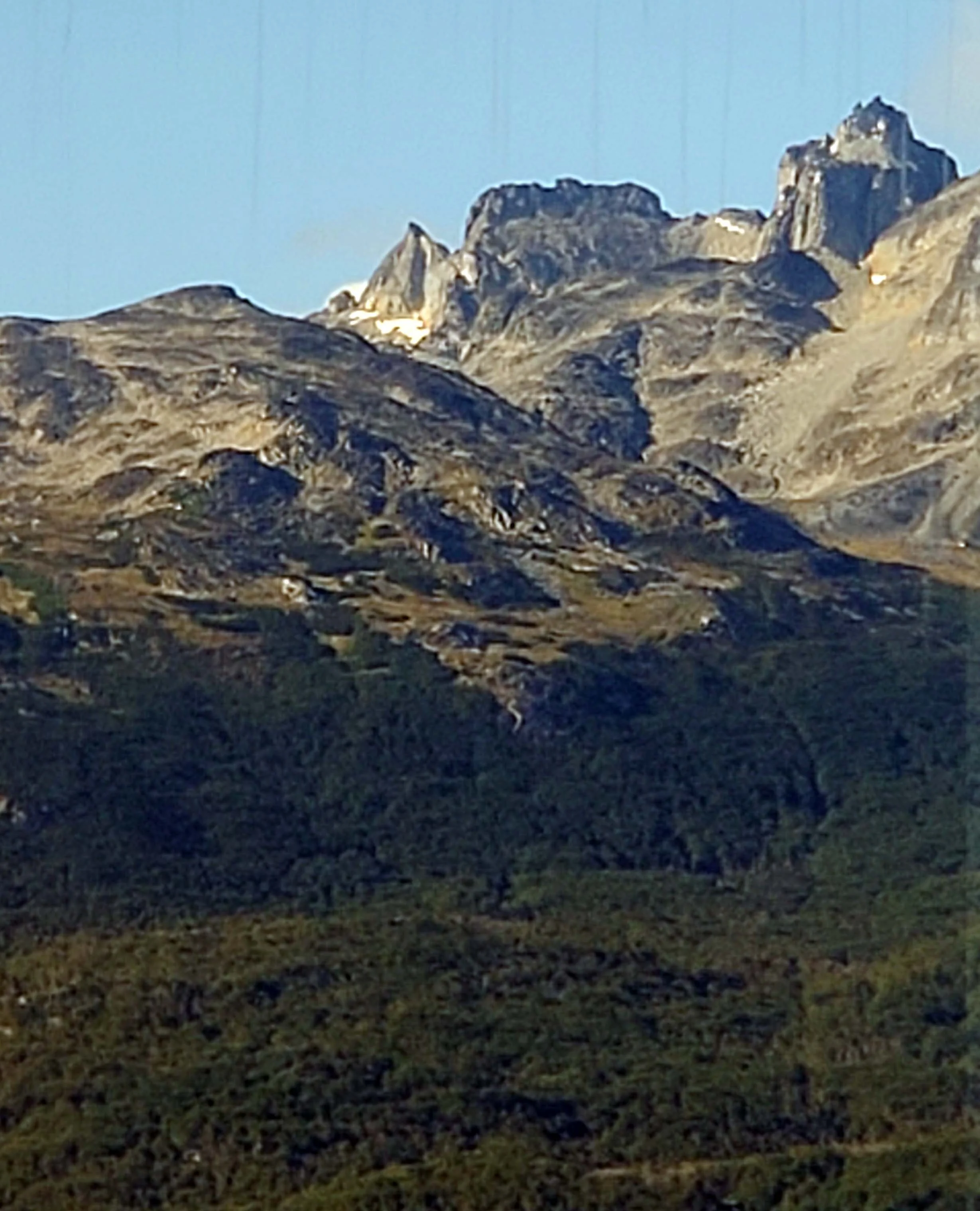
Patagonia’s Glacier Alley
At Ushuaia, Argentina, part of Patagonia and the southernmost city in the world, adventurers embark on journeys to Antarctica. We take a five-hour cruise on a catamaran in search of wildlife. We see sea lions, otters, and common murres, who look like penguins but aren’t even related. Finally, we come to an island where a large colony of Magellanic penguins greet us from a snowless summer beach.
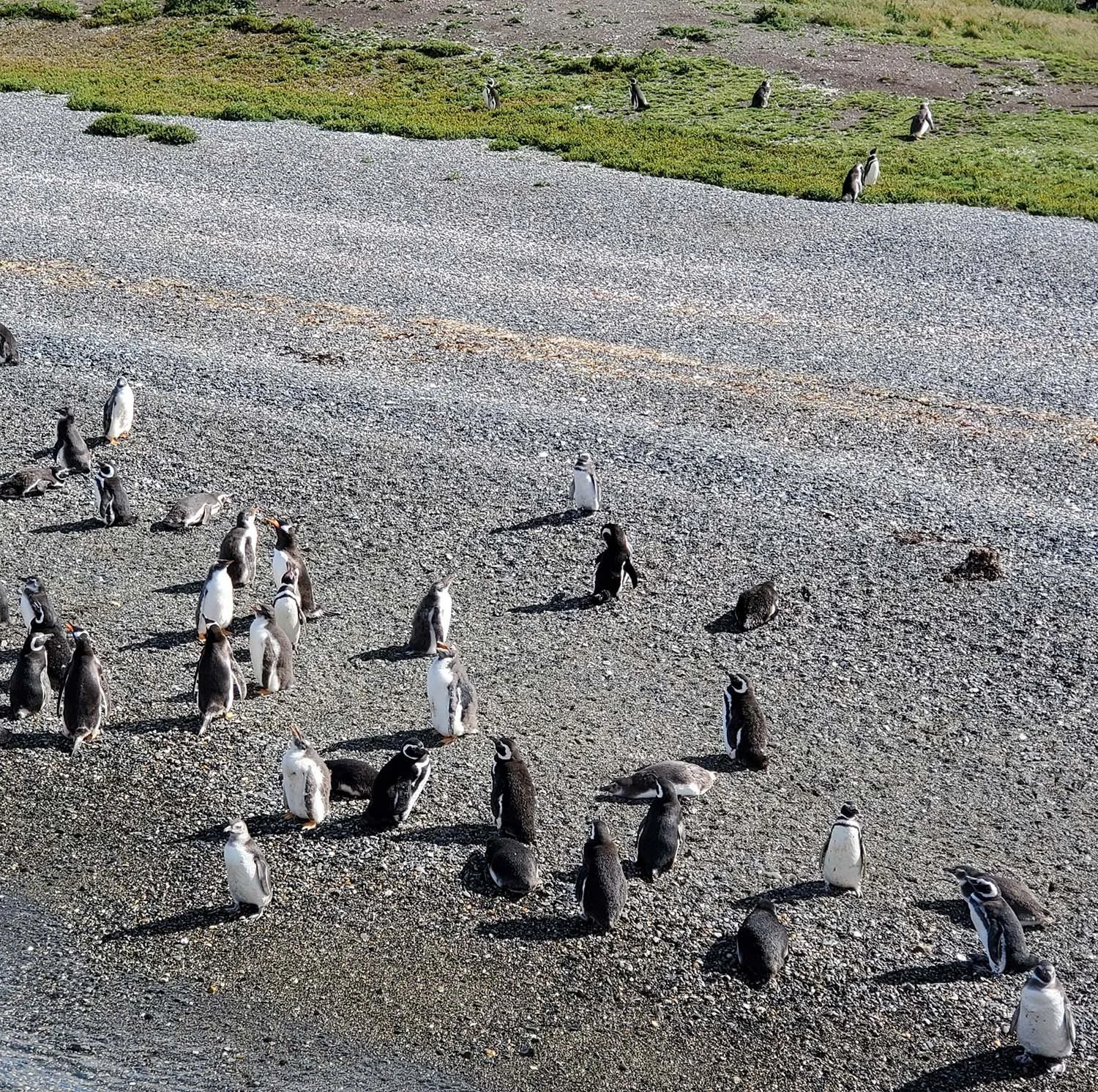
Magellanic Penguins
On a snowless summer beach near Ushuaia, Argentina, the Southernmost City in the world.
We had heard stories of rough crossings at Cape Horn and of cruisers who were disappointed because their passage was too smooth.
“We probably won’t actually round the horn,” Ron says to me. “Winds there can get up to 186 miles per hour. I think there is a channel the cruise ships use.”
“They said we would round the horn,” I answer. “I think that’s what we’re going to do.”
We agree that we’ll find out when we get there.
We do round the horn, passing the steep mountain cliff with its “light house at the end of the world.” The light is maintained by a Chilean Naval volunteer, who lives there with his family. The assignment is for a year. Food supplies are delivered every two months.
We are lucky. The sea for our crossing is rough enough to be satisfying, without being treacherous.
“What’ll we do with our Passing the Horn certificates?” Ron asks.
“I don’t know.”
“I guess they’ll go with our Grand Canyon Mule Skinners certificates,” he says with a grin.
In Port Stanley, Falkland Islands, our highly anticipated visit to the FitzRoy Sheep Farm is cancelled. We visit Gypsy Cove instead, a natural preserve six miles to the north. There, while most choose a vigorous hike, we get acquainted with a local tour guide and a bus driver on break. They both had been born and reared in the Falklands and went to school together. Each had been arrested by the Argentinians in the 1982 invasion.
The Falklands are a British Overseas Territory and had been a British colony since 1841. Argentina considers the Falklands to be their territory. On April 2, 1982, they invaded and occupied the islands in an act of reclamation.
Our tour guide leads us on an easy path to a nearby overlook and points out a nest of baby penguins. As we gaze at the cove’s clear blue water, white sand, and expanse of grassland, he tells us his story. He had been arrested on that very spot the first day of the invasion and he spent the rest of the 74-day war as a POW working and comfortably housed on a sheep farm. He introduces us to another guide and together they chat about the traumatic experiences their families had faced during that conflict..
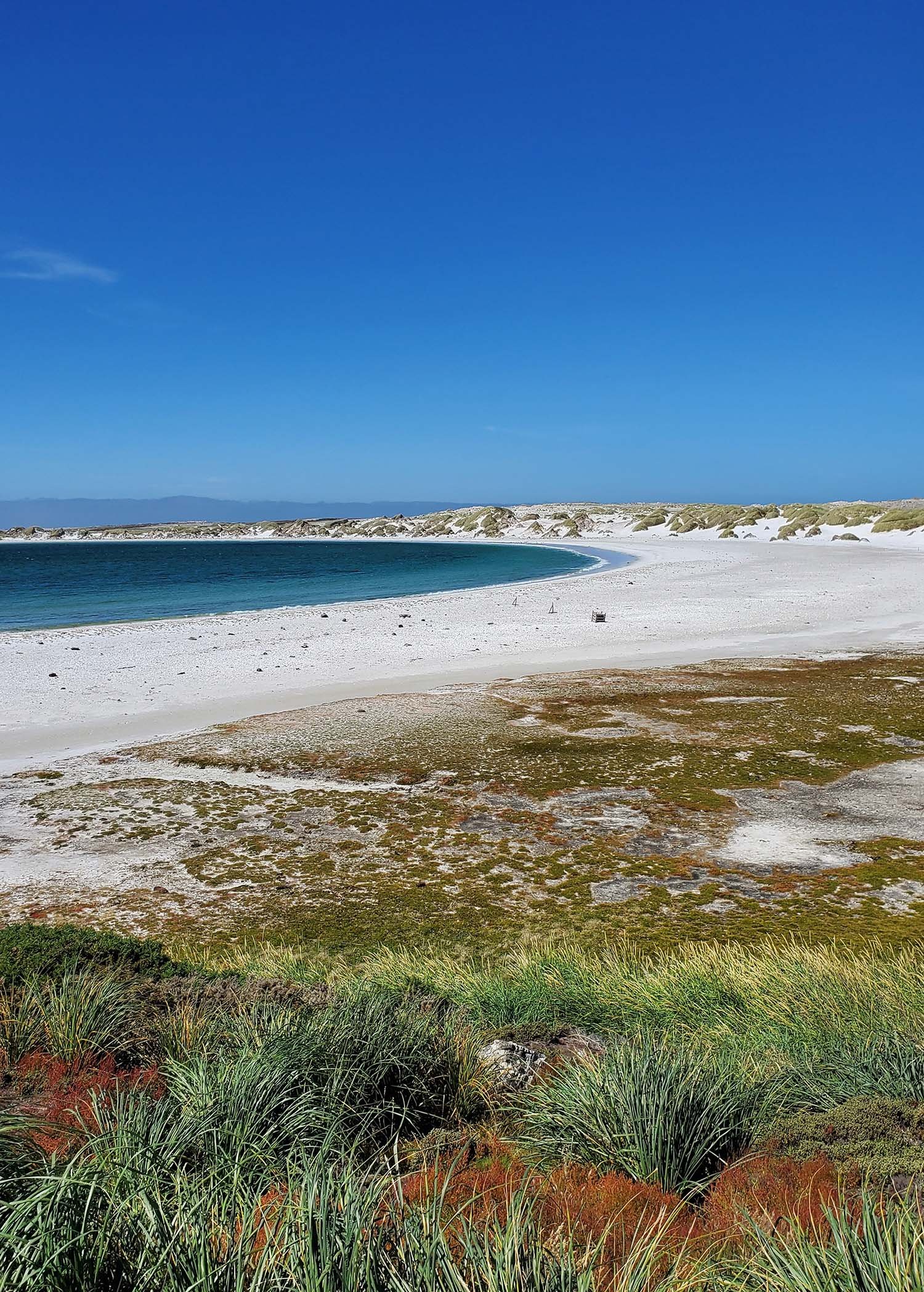
Gypsy Cove, The Falkland Islands
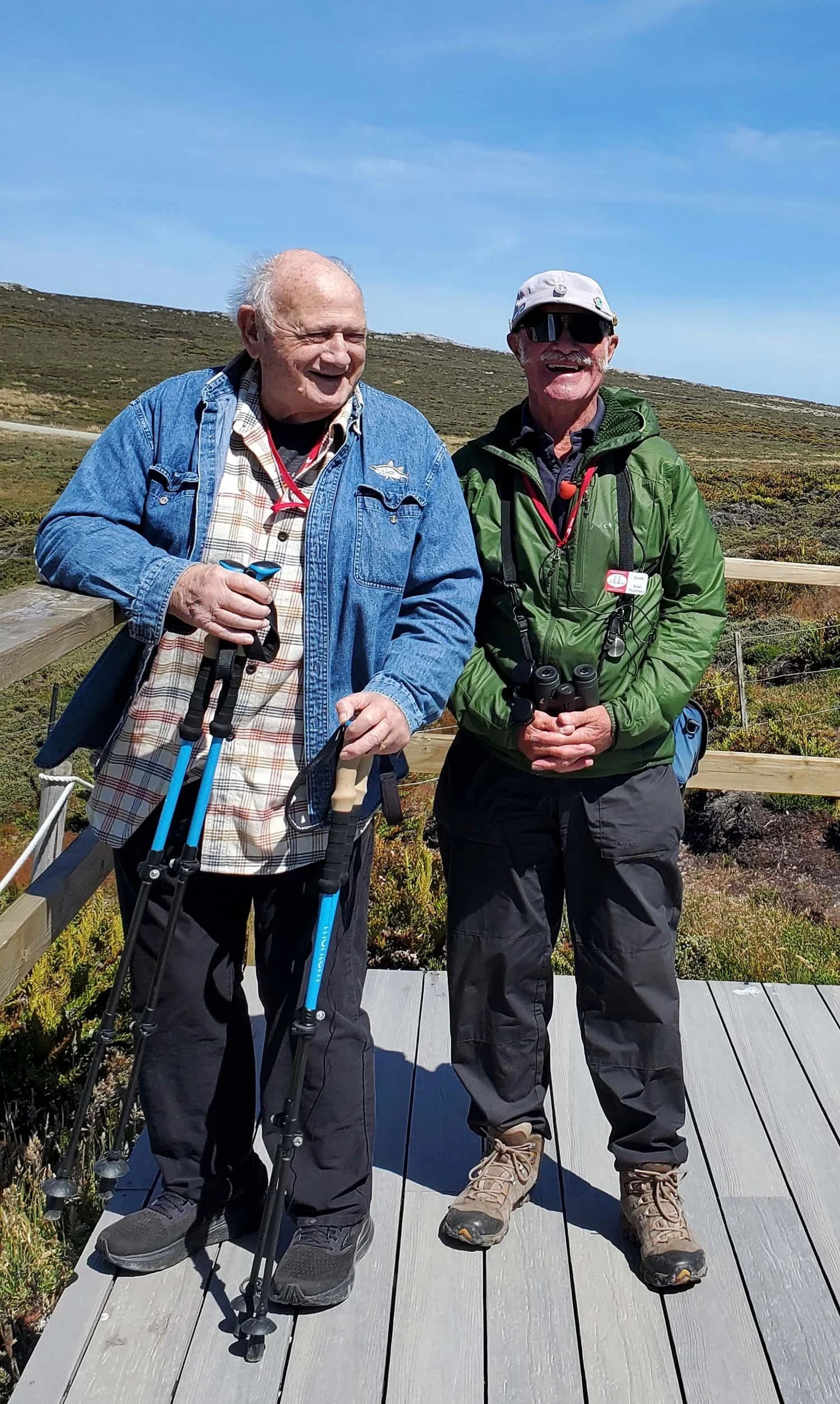
Ron and our Tour Guide
He tells us the story of his capture by the Argentinians on April 2, 1972, the first day of the War in the Falklands.
When we arrive at our waiting bus ahead of the hikers, the driver invites us in. We ask him a few questions and he tells us his personal war story. He had been a Royal Marine and was captured the first morning. A bag was placed over his head and he was flown somewhere. The plane landed once and took off again. He had no idea where he was going until he deplaned in England.
“England? Really?” we asked.
“Yes, they flew me to England, along with the Governor, his family, and other Marines.”
He tells us that three days later, he and the other Royal Marines flew back to the Falklands to fight the rest of the war that they ultimately won.
In the mid-1800s, the Argentinian government encouraged European immigration. At that time, families in Wales were seeking improved economic conditions and freedom to practice their Protestant religion and speak their Welsh language.
At Puerto Madryn, Argentina, we join two busloads of passengers traveling to the lower Chubut valley of the Patagonian Desert and the settlements of Dolavon (Welsh for “river”) and Gaiman (“meadow”). The Welsh language is still spoken there.
The first settlers had arrived in 1865 from mining towns in Wales. With few, if any hunting and farming skills, the settlers faced extreme hardships in the early years. Many died. In time, with help from the native Tehuelche, they gained survival skills and developed Argentina’s first irrigation system. They raised and exported world class wheat, winning gold medals at exhibitions in Paris and Chicago.
We visit the historic flour mill in Dolavon, now a restaurant and museum. In Gaiman, we stop at La Angostura (“The Narrows”), a berry farm that uses no sprays or insecticides and only natural fertilizers. They raise blueberries, blackberries, red raspberries, and elderberries. They make jellies, wines, and liqueurs to sell on site and at fairs and craft shows. We buy two jars of jelly.
Both Ron and I remember picking elderberries from bushes when we were children in Ohio and Connecticut. In Patagonia, we sit on a bench under a giant elderberry tree and learn that the wood from those trees was used by indigenous people to make musical instruments.
One more short bus ride takes us to the historic Bethel Chapels in Gaiman. The smaller and older of the two was built in 1880 of brick and stone. Inside the plain rugged hall, we sit on roughhewn benches and are gifted by the Gaiman Choir with a concert of traditional Welsh anthems and hymns. Their vocal harmonies ring like none I’ve heard before. The concert concludes with the national hymn CWM Rhondda by Welsh composer John Hughes. The tune is familiar to English speakers as God of Grace and God of Glory, with lyrics penned by Harry Emerson Fosdick for the dedication of New York City’s Riverside Church on October 5, 1930. That hymn has since been published worldwide in more than 170 hymnals.
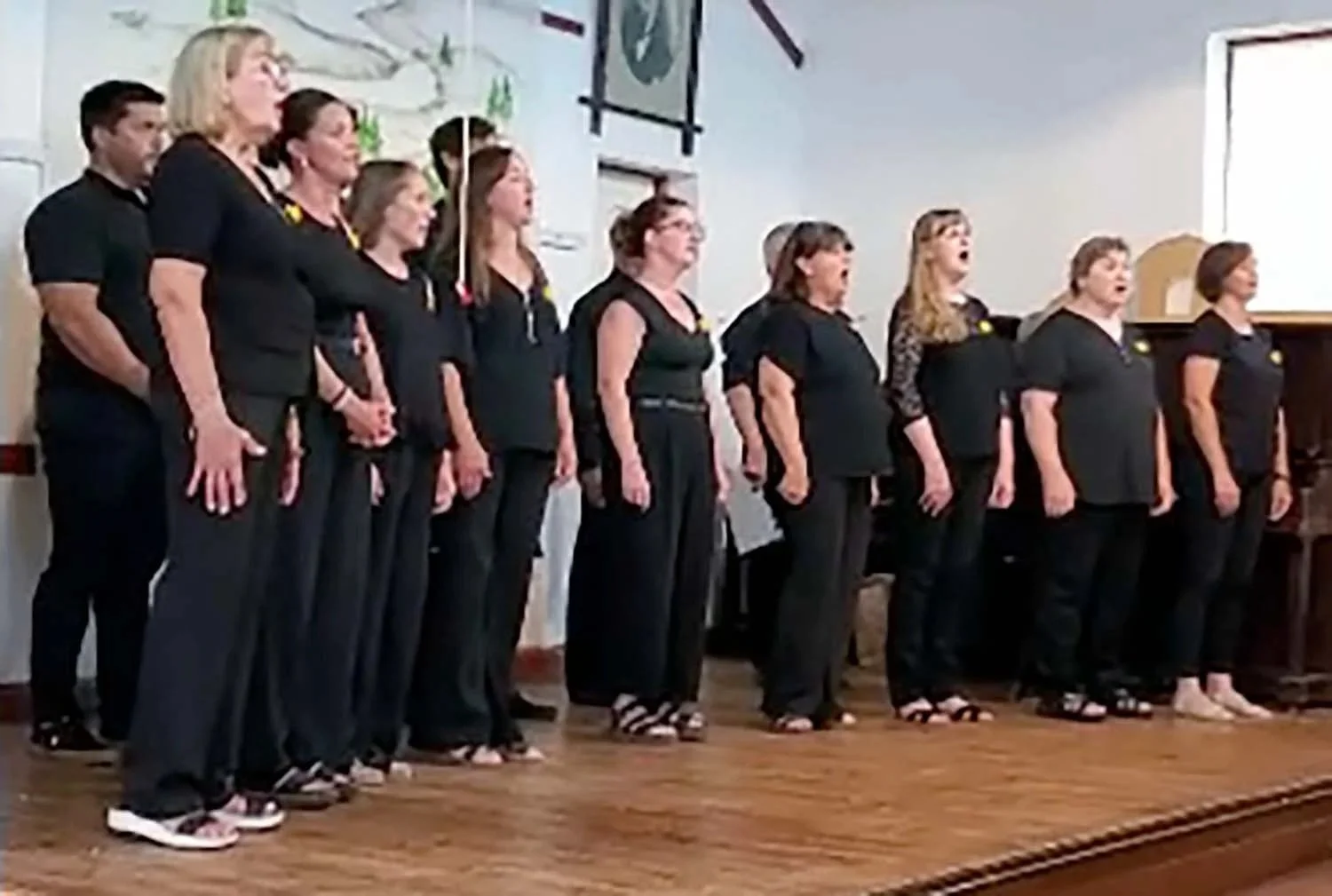
The Gaiman Choir sings the Welsh National Hymn CWM Rhondda in Welsh and Spanish.
“Grant us Wisdom, grant us courage for the living of these days.”
The Gaiman Choir spokesman tells us in English that they will sing the hymn first in Welsh, then in Spanish. He invites us to join them for a third round in whatever language we speak. The unique experience of singing the well-known refrain, Grant us wisdom, grant us courage for the living of these days, and hearing those words sung simultaneously in three or more languages in this unpretentious historic chapel deep in the heart of the Patagonian Desert, produces shivers of joy and brings tears to more than a few eyes.
In the final days of our cruise, we experience a wildly creative Carnival performance in Montevideo, Uruguay, and dazzling tango performances in Buenos Aires. But it is hard to beat the memory of that one moment when eighty fellow travelers from the United States, Canada, England, and Australia join a Welsh and Spanish-speaking choir in Gaiman, Argentina, to sing, “Grant us wisdom, grant us courage for the living of these days, for the living of these days.”