The Birth of a Garden
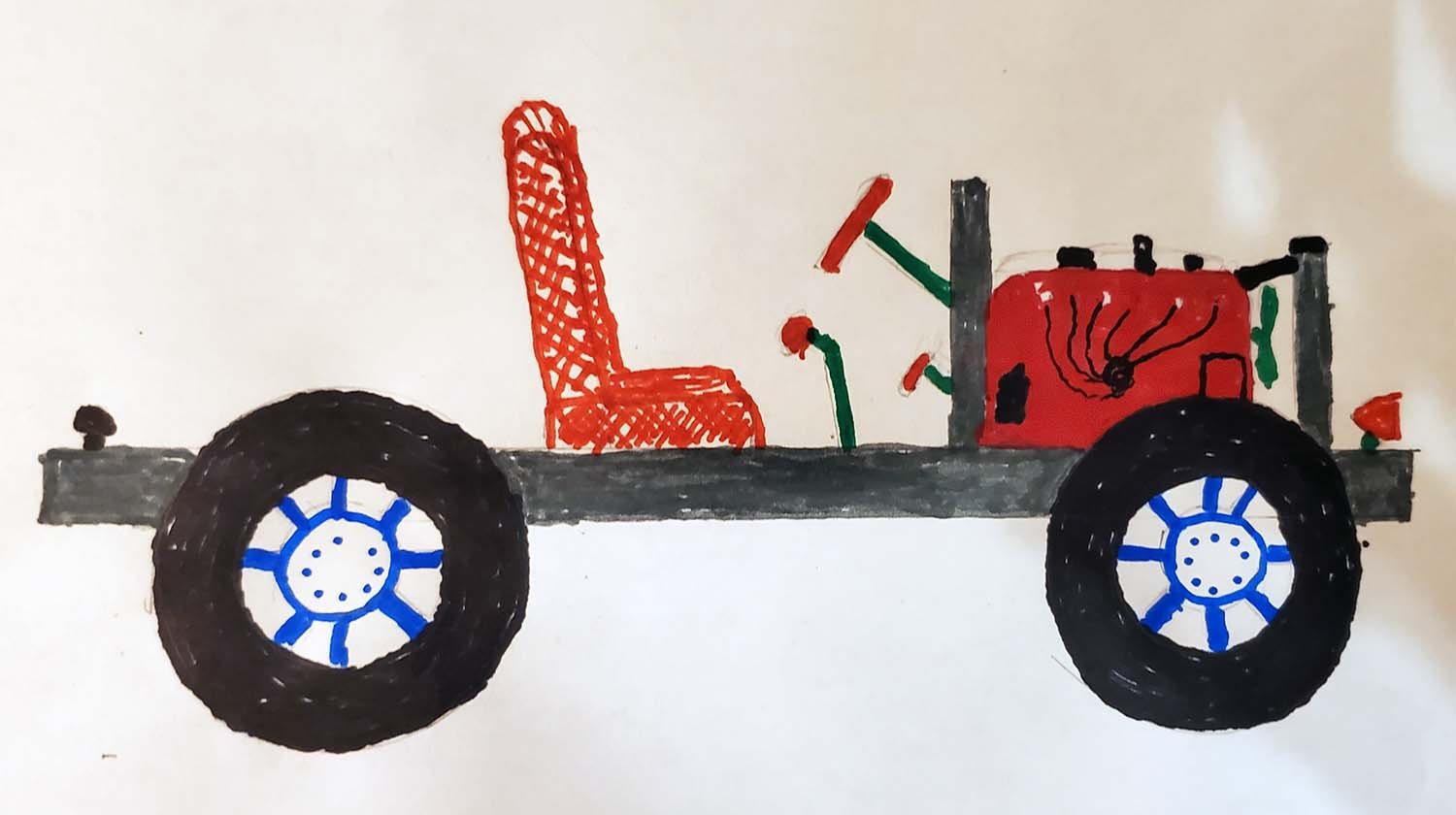
The Trucktor
One warm sunny Sunday afternoon in April 1946, Dad and I were discussing the Farmette. That was what I called our five acres, sort of a farm just not as big.
He said, “To make it a real Farmette it needs a garden. How do you feel about driving our tractor to pull the antique plow that I’ll steer behind you?”
I was eight years old.
I answered, “Yes sir, just show me how to do it.”
Our tractor was not a real tractor, rather half pick up and half tractor. I called it a trucktor. The cab as well as the bed had been removed. All that remained was the chassis with an engine, radiator, front seat, steering wheel, clutch, brake, gas tank and a floor mounted gear shift.
He showed me how to start the engine, use the clutch, put it in gear, use the brake and a few other minor (?) details. I drove to where the plow lay on its side, found reverse on the floor shifter and backed up to the horse drawn plow.
Dad hooked it up to the chassis with a chain and said, “Drag it over to where the garden starts.”
When I stopped, he turned the plow upright and said, “Let the clutch out real slow and stay in a straight line toward the wild cherry tree on the edge of the woods”
I was scared to death. I knew if something went wrong it would be entirely my fault.
Oh well, here we go.
About halfway down the garden Dad hollered, “Pull the throttle wire out a bit to speed up.”
I did. I guess I pulled it a bit too far.
He yelled, “Slow down, slow down!”
Then he hollered, “Stop! This will be the end of each furrow.”
I was ready for the worst.
As Dad stood there panting, he said, “Just a little less (gasp) speed than you gave it (gasp) but more than I had it set for (gasp) the first half of the row.”
That little bit of instruction gave me a ton of confidence. I knew now I could do the job and not worry too much about displeasing him. Within two hours we had a seventy- five- foot by thirty-five-foot garden.
Dad said, “Pull the plow back to where it was and disconnect it. Then bring the truck down to the house and park it.”
He then went to the patio.
How did he know I could unhook the plow? I hope he left the crescent wrenches in the toolbox. This could be a test to see if I was watching him while he hooked the plow to the chassis. I think he was happy with my driving. I didn’t make too many mistakes and all of them were small ones that I didn’t know about until he told me.
When I got to the patio, I asked him how we smooth the rough plow furrows.
He said, “Ron you did a good job today driving the trac… trucktor. I’m hoping that I can depend on you to get the garden in shape and ready for planting.”
I said, “Of course, but I don’t know how.”
He said, “Let’s think about the spike tooth drag. Hook it onto the trucktor, drag it to the plowed ground, pull the hand lever back to turn the spikes down, and it’s ready to use. You may want to adjust it to dig only half the depth of the spikes. In that case pull the hand lever only halfway down. Pull the drag over the plowed ground until it’s smooth. If you’re getting a lot of grass and weeds, your spikes are too deep. Raise it up a notch. You may have to drag for a couple of hours, and possibly for a day or two later if the soil seems too moist. In that case I’ll give you more instructions.”
Just before I left for school Tuesday morning, Dad came in from patching a large hole in the chicken wire on the far side of the coop and said, “Good work on the garden, Ron”
“Thanks,” I replied. “What’s next?”
“We’ll let it dry out for a day or two. Then it may need another session with the drag.”
“Yes sir, I’ll be ready. Just say when.”
Three days later, Dad hadn’t said any more about the garden. So, after school, I pulled the drag over the entire area for an hour with the teeth set at an inch deep.
Our furniture store was open until nine o’clock on Friday nights, so Dad didn’t get home until nearly ten o’clock.
As he sat eating his dinner and reading the paper, I told him, “I went ahead and ran the drag over the garden. I set it at an inch. I hope that was okay.”
“Exactly right! I hoped you would get it done this week.” He smiled and added, “Well done.”
Wow, he said I did exactly the right thing. It sounded like he expected me to just do it without even asking.
On Saturday morning I went to work with Dad at the furniture store. I took care of cutting the grass around the building, washed the display windows, dusted and vacuumed the display areas, and deep cleaned the used stoves and refrigerators. I also helped Uncle Reuel in the truck with light weight deliveries.
On our way home that evening, Dad stopped at the West End Hardware to buy plants and seeds.
He asked me, “How many tomato plants do we want?”
Since tomatoes were not one of my favorite foods at the time, I said, “Oh, I don’t know, maybe two or three plants.”
Dad frowned, shook his head, sort of giggled, and told the clerk a dozen Beefsteak tomato plants, a dozen Mortgage Lifters and a half dozen Golden Queens. He then ordered a dozen California Wonder pepper plants, a pound and a half of Vidalia onions, a pound of Golden Bantam and a pound of Country Gentleman sweet corn, a pound of green beans and a pound of peas. Then we went to the seed rack where we picked out packets of leaf lettuce, carrots, beets, summer squash, zucchini, watermelon, musk melon, Swiss chard, cucumber, and radish. Dad also ordered a fifty-pound bag of nitrogen to help fertilize the plants. We loaded our purchase into the old Pontiac and headed home.
Mom had dinner waiting for us and put it on the table while Dad and I washed our hands. All four of us-- Dad, Mom, two-year-old brother Norman, and I-- enjoyed a delicious fried chicken dinner.
Sunday morning after breakfast we measured the width between the truckter wheels and found it to be sixty-four inches, meaning the space between rows would be thirty-two inches which allowed the cultivator room to work when the time came.
Dad tossed the onion sets, corn seed, bag of nitrogen, stakes, a roll of twine, a small roll of tarpaper, scissors, masking tape, a shovel, a hoe and a pail of water into the wheelbarrow and carefully placed the foot-long plants on top. He then pushed it to the location of the first row.
With a stake at each end of the garden, we tied a piece of twine end-to-end and added a stake at each quarter of the length to keep the wind from blowing the twine out of line.
Now with our row marker in place, Dad began my lessons in planting. He removed a shovel of dirt, put about a cup of water in the hole, and a half teaspoon of nitrogen. He selected a Beefsteak plant and placed it in the watered hole, leaving a three-inch stem below the plant’s first limb.
Then he pushed the loose dirt in around the plant.
He cut a piece of tarpaper three inches by nine inches, formed a tube to go around the stem of the plant about an inch out from the stem, placed the tube around the plant that extended two inches above the soil and taped it closed saying, “This will prevent cutworms from getting to the plant and cutting the stem. The finishing touch is to spread a spoonful of nitrogen around the outside of the cutworm wall. This will improve the soil, helping the root system to spread.”
Dad looked at me and said, “I know this is a lot to remember, but you have a model to use for the tomatoes and peppers. The corn and onions will be much easier.”
I replied, “I think it will be okay. How far apart should I plant the tomatoes and peppers?”
“About twenty-four inches. I think the peppers should start the second row, and the onions follow in that row.” He continued, “To plant the onions take the corner of the hoe and make a three-inch canal under the row marker. Place the onions pointed side up, about three inches apart. Cover the canal with three to four inches of soil.”
I asked, “What about the sweet corn?”
“I think it should be on the front side of the garden. What do you think?”
I said, “Sounds good to me. How close do the kernels go and which kind starts the row?”
He answered, “Make a row of each kind. Use the corner of the hoe making a two-inch deep hole, eight to ten inches apart with two or three kernels per hole. Push dirt back into the hole and step on it when filled.”
He looked at me, nodded, smiled and turned to go.
“Okay, see you later. Thanks for teaching me the different ways of planting. I hope I get everything right in your garden.”
At that he paused, turned and said, “This is more your garden than mine. I’m just furnishing the method and the money. You’re doing the hard part. Keep up the good work.”
And he was gone.
Wow! He said the garden was mine. He was right. It is a lot of hard work, but fun. I can’t wait to see all the plants growing. I wonder when we, or I, will plant the other seeds. Dad said the soil had to get a bit warmer before the others got planted.
At about one o’clock, Mom and Norman came to see how I was doing and brought a jug of water and a chicken sandwich. I was hungry, and the sandwich hit the spot. I asked where Dad was. I had a question to ask him about the rows of corn.
Mom said, “Just do it the way you think best. Your father won’t be home for a couple of hours. He knows you will solve any problem that may develop in the garden.”
And so it went, the rest of the spring and on into the summer. Dad either showed me or told me how to plant everything. He also gave me many thoughts and ideas he had used as a boy in caring for an earlier garden. When time to cultivate arrived, I drove the truckter and Dad rode the horse drawn antique iron wheeled cultivator.
When finished cultivating and hoeing that first time, Dad stood looking at the results and smiled, “Be proud, Ron. You have done a man’s work on this project and have earned a man’s respect for it.”